

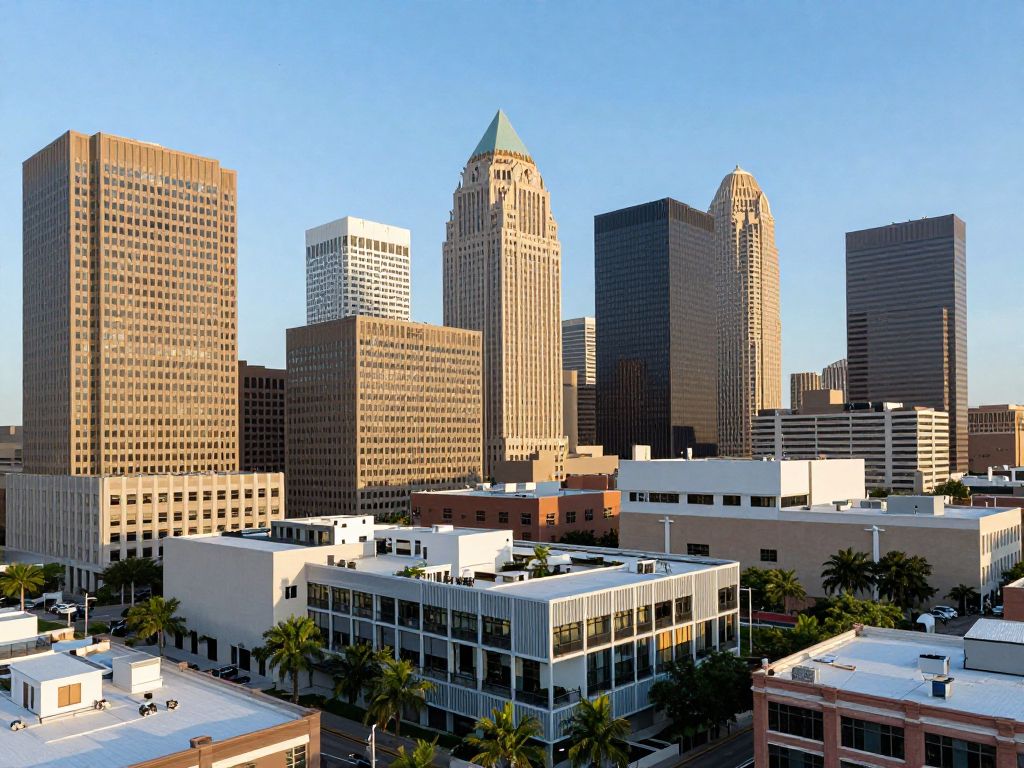
Houston, TX, January 21, 2026
Houston’s commercial real estate is experiencing a transformative period characterized by increased office vacancy rates and a significant rise in flexible coworking spaces. As traditional work models are reevaluated, the adaptability and resilience of Houston’s economy play a vital role in fostering a dynamic entrepreneurial landscape. Despite an overall office vacancy rate that remains a concern, the strong job growth and demand for coworking environments signal positive trends in the local business ecosystem. The city’s ongoing innovation and commitment to supporting local enterprises remain key to sustaining economic development.
Houston, TX
Houston’s Office Market: Shifting Sands & Smart Solutions
As commercial vacancy rates in Houston adjust to evolving workplace dynamics and new construction maintains a thoughtful pace, flexible coworking spaces are demonstrating their competitive edge, serving as a vital backbone for the city’s dynamic entrepreneurial landscape.
The Resilient Spirit of Houston’s Economy
Houston has long been a beacon of economic activity, defined by the determination of its entrepreneurs and the adaptive capacity of its business community. In an era where traditional work models are being re-evaluated, the city’s commercial real estate market is undergoing a significant transformation. This evolution highlights a vibrant local economy poised for continued growth, driven by pragmatic adaptation and the inherent flexibility that allows businesses to thrive amidst change. The city’s ability to absorb new residents and foster a pro-business environment remains a key factor in its ongoing success, reinforcing long-term regional demand.
The latest economic indicators underscore Houston’s robust position. The metro’s unemployment rate decreased to 4.4% in October 2023, outpacing the state’s 4.1% and the national rate of 3.9%. By October 2023, Houston’s employment reached 3.4 million, demonstrating an annualized growth of 3.7%, equivalent to 30,474 new jobs in the three months ending in October. Looking further ahead to Q2 2024, the Houston economy remained strong with nearly 90,000 jobs created over the past year, and a relatively low unemployment rate of 4.0%. This consistent job creation and a growing labor force signify an underlying strength that empowers local businesses and attracts new investment.
Office Vacancy Rates: A Nuanced Picture
The trajectory of Houston’s office vacancy rates presents a complex, yet understandable, market adjustment. By the end of Q4 2023, the overall vacancy rate in the Houston office market was 24.9%. This represented a quarter-over-quarter decrease of 20 basis points from 25.1%, though it marked a year-over-year increase of 30 basis points from 24.6%. As of Q2 2024, the Houston office vacancy rate increased by 80 basis points year over year to 25.4%, which is above the long-term average of 16.8%. Quarter over quarter, vacancy rates experienced no change as absorption slightly outpaced deliveries. The overall vacancy rate in Houston’s office market held steady at 26.1% in Q4 2024, unchanged from the previous quarter but up 30 basis points from one year prior. For Class A properties, the Q4 2024 vacancy rate was 27.5%, while Class B properties saw a 24.1% vacancy rate.
A specific report from September 2024 indicated Houston held the second highest office vacancy rate nationwide at 18.6%, reflecting a 1.6% increase since 2023. This translated to approximately 66.30 million square feet of empty office space. However, data for October 2025 showed a vacancy rate of 29.9%, with newer Class A properties continuing to outperform. By Q4 2025, the overall vacancy rate reached 24.8%, a 30 basis point increase from the previous quarter. Notably, newer buildings completed within the last 15 years averaged a 15.3% vacancy rate in Q4 2025, significantly lower than the 28.1% in older, vintage buildings built before 2009. This “flight-to-quality” trend, where tenants prefer higher-quality, amenity-rich Class A spaces, is a consistent theme in the market, with Class A space accounting for 87% of the positive net absorption in Q4 2023.
Construction Activity: A Measured Approach
The pace of new office construction in Houston has shown signs of leveling off, aligning with a more cautious market outlook. By the end of Q4 2023, office construction accounted for 1.4 million square feet across 10 buildings, with 26% of that space, or 375,581 square feet, available for lease. This figure indicates a significant slowdown when compared to the average annual construction of 3.6 million square feet over the prior three years. Deliveries of new office space in Q4 2023, however, surged to 1.3 million square feet, marking the first time in two years that deliveries surpassed the 1 million square foot threshold.
More recently, Q4 2024 saw new office deliveries at 31,111 square feet, an 83% decrease from the previous year. The construction pipeline for office space has also been trending downward, resting at 1.3 million square feet, which is 55% less than one year prior. While office construction sees a more measured pace, broader commercial construction starts nationwide were up 8% in 2024, contributing to a 6% overall increase in total construction starts compared to 2023. Houston continues to see significant overall development, including major mixed-use projects and hubs for advanced manufacturing and life sciences, underscoring a diversified approach to growth beyond traditional office spaces.
The Ascendancy of Coworking Spaces
In response to evolving work preferences, Houston’s coworking sector has not just maintained a competitive edge but has also expanded significantly, providing crucial flexibility for Texas TX entrepreneurs and Houston small business owners. Coworking spaces have fundamentally transformed how individuals and teams operate, offering collaborative environments that resonate with the modern workforce.
Houston’s coworking space inventory experienced a substantial 16% growth between March and June of 2023, surpassing the national average of 10% during the same period. With over 4.16 million square feet of coworking space, Houston holds the distinction of having the highest amount of coworking space among all U.S. cities, excluding New York City and Los Angeles. This impressive expansion saw Houston rise to rank seventh nationally for the number of coworking facilities, ahead of cities like Boston. The demand for such flexible arrangements is evident, with freelancers and remote workers constituting the majority, at 65%, of coworking space members in Houston. The growth in flexible office space in Houston, including coworking, was a notable exception nationwide, increasing by 5.3% between Q4 2020 and Q3 2021, even as many other major metropolitan areas experienced contractions.
Fueling Entrepreneurial Innovation in the Bayou City
Houston’s economic landscape is not merely adapting; it is actively innovating. The city has earned recognition as the number one city in the U.S. for the fastest-growing businesses, with an Average Business Growth (ABG) of 26.7% in a 2024 study. This robust growth is further exemplified by Texas securing its 13th consecutive Governor’s Cup in 2024, an award recognizing the highest number of qualified capital investment projects statewide. Houston played a significant role, ranking third among U.S. metropolitan areas for attracting new business ventures, with 435 projects in 2024.
The city’s commitment to nurturing Houston’s innovation ecosystem is evident. Over the past five years, venture-backed startups in Houston have secured over $6 billion in funding. The number of startups in Houston has increased by 825% since 2017, now totaling approximately 1,300 active startups, which have collectively raised nearly $12 billion in funding. More than 80 startup development organizations, including incubators, accelerators, and coworking spaces, form a growing network of resources for Houston TX business owners. This supportive environment, coupled with the city leading the nation in exports at over $180 billion annually and ranking second for STEM job growth, underscores a dynamic and opportunity-rich environment for personal achievement and private enterprise.
Adapting to Market Realities: A Path Forward
The trends in Houston’s commercial real estate, particularly the shifts in office vacancy and the rise of coworking, reflect a broader recalibration in how businesses approach workspace. The emphasis on “flight-to-quality” in traditional office leasing, where tenants seek modern, high-amenity spaces, suggests a strategic allocation of resources. This prudent approach aligns with a business philosophy that prioritizes efficiency and value in real estate investments. Simultaneously, the sustained expansion of coworking options underscores a market driven by flexibility and responsiveness to the varied needs of a diverse workforce, from burgeoning startups to established enterprises. The demand for flexible work models, a significant factor in the changing office landscape, has also contributed to a slight uptick in Houston’s office rental prices, which reached $30 per square foot.
Houston’s appeal as a location for economic growth is reinforced by its cost of living, which remains 7.4 percent below the U.S. urban average. This affordability, combined with a business-friendly environment and robust infrastructure, positions the city favorably for continued investment and job creation. The diversification of Houston’s economy, with strong growth in areas beyond traditional energy, provides a stable foundation for future development and opportunity.
Conclusion
Houston’s commercial real estate market is navigating a period of significant transformation with characteristic resilience and ingenuity. While office vacancy rates continue to adjust, a more discerning approach to traditional office space is emerging, coupled with a robust expansion of flexible coworking solutions. These trends are not merely challenges but opportunities, reflecting a dynamic market adapting to the preferences of a modern workforce and the innovative spirit of Houston’s entrepreneurs. The city’s ongoing commitment to fostering a supportive ecosystem for businesses, from startups to large corporations, ensures that Houston remains a fertile ground for economic growth and personal success. Supporting local businesses and engaging with the evolving landscape of commercial real estate will be key to Houston’s continued prosperity, building on its foundation of innovation and adaptability.
Frequently Asked Questions
What is the current office vacancy rate in Houston?
The overall office vacancy rate in Houston’s office market was 26.1% in Q4 2024, remaining unchanged quarter-over-quarter but representing an increase of 30 basis points from one year prior.
How has office construction changed in Houston recently?
In Q4 2024, new office deliveries in Houston were 31,111 square feet, an 83% decrease from the previous year. The office construction pipeline also showed a downward trend, totaling 1.3 million square feet, which is a 55% reduction compared to one year ago.
Is the coworking market growing in Houston?
Yes, Houston’s coworking space inventory grew by 16% between March and June of 2023, outpacing the national average growth of 10%. Houston possesses over 4.16 million square feet of coworking space, making it the city with the highest amount outside of New York City and Los Angeles.
What percentage of coworking members in Houston are freelancers or remote workers?
Freelancers and remote workers constitute the majority of coworking space members in Houston, accounting for 65%.
How does Houston rank for business growth in the U.S.?
According to a 2024 study, Houston was named the number one city in the U.S. for the fastest-growing businesses, achieving an Average Business Growth (ABG) of 26.7%.
Has Houston attracted new business ventures recently?
Yes, Houston secured the third spot among top U.S. metropolitan areas for attracting new business ventures in 2024, with 435 projects.
What is the unemployment rate in Houston?
Houston’s unemployment rate decreased to 4.4% in October 2023, which was lower than the state rate of 4.1% and the national rate of 3.9%. By Q2 2024, the unemployment rate was relatively low at 4.0%.
Key Features of Houston’s Commercial Real Estate Market
| Feature | Details | Scope |
|---|---|---|
| Q4 2024 Office Vacancy Rate | 26.1% (unchanged quarter-over-quarter, +30 bps year-over-year) | Houston |
| Q4 2024 New Office Deliveries | 31,111 sq. ft. (-83% from last year) | Houston |
| Coworking Space Growth (March-June 2023) | 16% (faster than national average of 10%) | Houston |
| Total Coworking Space | Over 4.16 million sq. ft. (highest outside NYC and LA) | Houston |
| Freelancers/Remote Workers in Coworking | 65% of members | Houston |
| Ranking for Fastest Growing Businesses (2024 study) | No. 1 in U.S. (26.7% Average Business Growth) | U.S. |
| Ranking for Attracting New Business Ventures (2024) | No. 3 among U.S. metros (435 projects) | U.S. |
| Unemployment Rate (October 2023) | 4.4% (Houston) | Houston |
| Cost of Living | 7.4% below U.S. urban average | U.S. |
Deeper Dive: News & Info About This Topic
HERE Resources
Fortifying Digital Defenses for Houston’s Economy
Midstream Innovator Boosts Downtown Houston’s Newest Tower
Texas Tech Reinforces Football Roster Through Transfer Portal
True Protection Expands Commercial Security Services in Houston
First In-Custody Death of 2026 in Harris County
Top 5 Renovation Tips for Houston Homeowners
Houston Area Sees Industrial Boost with Rockefeller Group’s Baytown Project Sale
Houston Accelerator Drives Local Business Growth
Google Chooses Houston: The Galleria Welcomes Tech Giant
UT McCombs to Relocate Houston MBA Program at CityCentre

Author: STAFF HERE HOUSTON TX WRITER
The HOUSTON STAFF WRITER represents the experienced team at HEREHouston.com, your go-to source for actionable local news and information in Houston, Harris County, and beyond. Specializing in "news you can use," we cover essential topics like product reviews for personal and business needs, local business directories, politics, real estate trends, neighborhood insights, and state news affecting the area—with deep expertise drawn from years of dedicated reporting and strong community input, including local press releases and business updates. We deliver top reporting on high-value events such as Houston Livestock Show and Rodeo, Art Car Parade, and Chevron Houston Marathon. Our coverage extends to key organizations like the Greater Houston Partnership and Houston Area Urban League, plus leading businesses in energy and healthcare that power the local economy such as ExxonMobil, Schlumberger, and Houston Methodist. As part of the broader HERE network, including HEREAustinTX.com, HERECollegeStation.com, HEREDallas.com, and HERESanAntonio.com, we provide comprehensive, credible insights into Texas's dynamic landscape.