

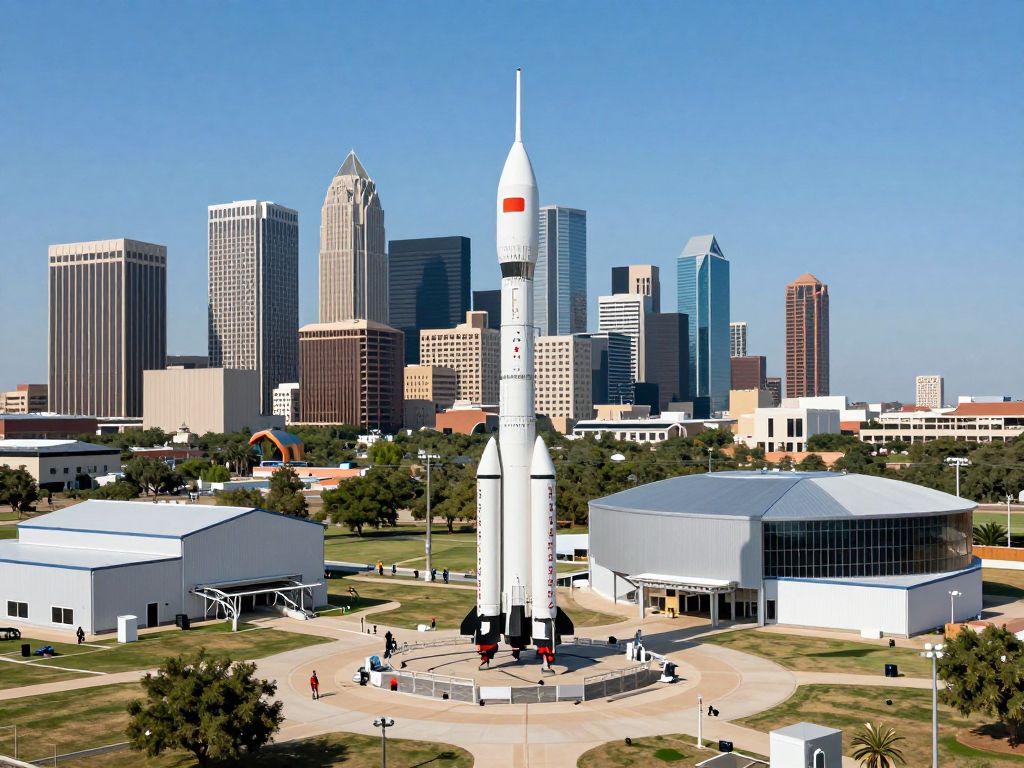
Houston, February 19, 2026
Texas is investing $150 million to enhance its space industry, aiming to encourage innovation and economic growth. The funding, allocated through the Texas Space Commission, will support various projects, including research and infrastructure development, fostering collaboration between public and private sectors. This initiative is set to create high-skill job opportunities and solidify Texas’s position as a leader in the global space economy, with significant contributions anticipated from educational institutions and private companies.
Houston Forges New Frontiers with Texas Space Commission’s $150 Million Investment
Houston, TX – Texas is strategically investing $150 million to significantly bolster its burgeoning space industry, a move poised to accelerate innovation, foster economic expansion, and secure the state’s position as a global leader in commercial and exploratory space endeavors. This substantial funding, channeled through the Texas Space Commission, underscores a commitment to entrepreneurial spirit and technological advancement, promising robust growth across key sectors and communities throughout the state.
The allocation of these grants reflects a forward-thinking approach to economic development, emphasizing private sector ingenuity and academic excellence. By supporting a diverse array of projects from cutting-edge research to the development of critical infrastructure, Texas aims to cultivate a dynamic environment where innovation thrives, new businesses emerge, and high-skill job opportunities expand, solidifying its place at the forefront of the new space economy.
Catalyzing Space Sector Innovation
The Texas Space Commission, established in 2023 by the Texas Legislature, was endowed with an initial $150 million from the Space Exploration and Aeronautics Research Fund (SEARF) to stimulate the state’s space ecosystem. This funding is part of a larger $350 million investment, with an additional $300 million later provided for grants and a further $200 million dedicated to a new Texas A&M Space Institute. The Commission’s mission is to expand Texas’ space business and advance innovation in space exploration and commercial aerospace.
Government entities, higher-learning institutions, businesses, and nonprofits were eligible applicants for these grants, fostering a wide net for innovative proposals. This strategic approach ensures that public and private sectors collaborate to drive progress across critical areas of space development.
Investing in Groundbreaking Research and Development
University-Led Advancements
A significant portion of the funding is directed towards enhancing academic research and development. Rice University, for example, received $14.2 million to establish a Center for Space Technologies. This center will focus on research and development, technology transfer, state-wide partnerships, workforce development training, and space-focused education programs. A primary goal is to advance sustainable human lunar exploration and In-Situ Resource Development and Utilization (ISRDU), which are crucial elements of NASA’s Artemis program.
Similarly, The University of Texas at Austin was awarded $9.3 million to develop a laboratory dedicated to studying “space domain awareness challenges,” aiming to improve the tracking of objects in orbit. These investments in higher education are designed to cultivate the next generation of aerospace professionals and drive intellectual capital within the state, reinforcing Texas’s already strong academic foundations in science and engineering.
Furthermore, the Texas A&M System is constructing a $200 million research and training facility adjacent to the NASA Johnson Space Center. This institute will specialize in lunar and Mars exploration, advanced aeronautics research, robotics, and offer critical workforce training for the expanding space industry.
Commercial Space Technology
Beyond academic institutions, the grants are fueling private sector innovation. Axiom Space, a key player in the commercial space arena, received up to $5.5 million to develop its Orbital Data Center (ODC) capabilities. These ODCs are designed to support a wide array of national security, civil, and commercial applications, including artificial intelligence/machine learning, cyber and quantum security, advanced communications, and defense applications. Initial free-flying ODC nodes are anticipated to launch by the end of 2025, marking a significant step towards a scalable orbital computing architecture.
Other funded projects span a range of innovative areas, including the study of inland launch pads, the development of fake moon soil, and advancements in lithium-ion battery technology for space applications. These diverse investments highlight Texas’s commitment to supporting a broad spectrum of space-related ventures, from fundamental research to practical commercial applications.
Expanding Texas’s Space Infrastructure and Workforce
The grants are also crucial for bolstering Texas’s physical and human infrastructure for space operations. Feasibility studies for potential inland rocket launch pads in west and northwest Texas have received funding through grants to the Concho Valley Council of Governments and the South Plains Association of Governments. This initiative addresses growing capacity constraints at coastal launch sites and mitigates risks associated with weather events, such as hurricanes. The exploration of inland launch capabilities demonstrates a pragmatic approach to enhancing national space resilience.
Workforce development is a key component of the Texas Space Commission’s strategy. The funding supports training initiatives designed to equip Texans with the skills needed for the evolving demands of the space industry. This includes specialized programs such as the Space Tech Entrepreneurship specialization offered at UT Austin, which integrates aerospace technology, business, and entrepreneurship to prepare students for leadership roles in this emerging marketplace.
A Business-Friendly Climate for Space Sector Growth
Texas has long been recognized for its supportive business environment, a factor that continues to attract and retain leading aerospace companies. With no state personal income tax or corporate income tax and lower payroll taxes, businesses in Texas can reinvest more into innovation and expansion. This fiscally attractive climate, coupled with a strategic vision supported by initiatives like the Texas Space Commission, positions the state as an ideal location for the space industry to flourish. Over 2,100 aerospace companies, including industry giants like SpaceX and Blue Origin, already have a significant presence in Texas, benefiting from this pro-growth environment.
The state’s existing infrastructure, which includes NASA’s Johnson Space Center in Houston and four FAA-licensed spaceports (Houston, Midland, SpaceX’s Starbase near Brownsville, and Blue Origin’s site near Van Horn), provides an unmatched ecosystem for space exploration and commercialization. The establishment of entities like the Central Texas Spaceport Development Corporation further demonstrates local commitment to attracting investment and fostering growth within the space sector.
Texas’s Role in the Global Space Economy
With these strategic investments, Texas aims to strengthen its leadership across civil, commercial, and military aerospace domains, competing effectively with other major space states. The Texas space industry already makes a substantial economic impact, contributing significantly to job creation and personal income across the state. For instance, the NASA Johnson Space Center alone generates an estimated $118.7 million in economic impact and supports 1,710 jobs in the greater Houston area. This investment ensures Texas remains a central hub for cutting-edge space research, development, and commercial ventures, driving Texas economic growth and offering unparalleled opportunities for Texas TX entrepreneurs.
Conclusion
The Texas Space Commission’s allocation of $150 million marks a pivotal moment for the state’s space industry, demonstrating a clear commitment to fostering entrepreneurial innovation and economic prosperity. By strategically investing in research, infrastructure, and workforce development, Texas is not only preparing for the future of space exploration but also creating a vibrant landscape for Houston TX business and Houston small business to thrive. As these projects take flight, Texans can look forward to new opportunities, advanced technologies, and a strengthened economy. We encourage all Texans to stay engaged and support the groundbreaking advancements that are propelling our state into the next frontier of human endeavor.
Frequently Asked Questions
What is the purpose of the $150 million funding Texas is using for its space push?
The $150 million funding is intended to stimulate the state’s space ecosystem, expand Texas’ space business, and advance innovation in space exploration and commercial aerospace.
Who received the grants from the Texas Space Commission?
Government entities, higher-learning institutions, businesses, and nonprofits were eligible to apply and received grants.
What are some key project areas supported by this funding?
Key project areas include studying inland launch pads, bolstering university programs, developing Orbital Data Center (ODC) capabilities, researching fake moon soil, advancing lithium-ion battery packs, and supporting STEM education.
Which universities received significant grants for space-related projects?
Rice University received $14.2 million to create a Center for Space Technologies, and The University of Texas at Austin received $9.3 million for a lab to study “space domain awareness challenges”.
How does Texas’s business environment support the space industry?
Texas offers a business-friendly climate with no state personal income tax or corporate income tax, and lower payroll taxes, allowing businesses to reinvest into innovation.
Key Features of Texas’s Space Initiative
| Feature | Description | Scope |
|---|---|---|
| Total Funding Allocated by Texas Legislature | $150 million specifically for Space Commission grants, part of a larger $350 million initial investment, with another $300 million for grants and $200 million for a Texas A&M Space Institute. | State-level |
| Number of Projects Funded | 24 projects divided among various entities. | State-level |
| Grant Recipients | Government entities, higher-learning institutions, businesses, and nonprofits. | State-level |
| Focus Areas | Inland launch pad studies, university research, commercial space technology, workforce development, STEM education, space infrastructure. | State-level |
| Economic Impact of NASA Johnson Space Center (Houston) | $118.7 million in economic impact and 1,710 jobs in the greater Houston area. | Local (Houston) |
| Key Participating Universities | Rice University, The University of Texas at Austin, Texas A&M System. | State-level |
| Business Environment | No state personal income tax or corporate income tax, lower payroll taxes. | State-level |
| Number of Aerospace Companies in Texas | Over 2,100, including SpaceX, Blue Origin, Boeing, Lockheed Martin. | State-level |
Deeper Dive: News & Info About This Topic
HERE Resources
Walgreens to Close Houston Distribution Center Affecting 159 Jobs
University of Texas Unveils New Medical Campus Location
Houston Welcomes New Tesla Battery Factory Investment
Houston Welcomes New VEVOR Store Enhancing Cy-Fair Economy
Houston FinTech Navigates Complex Data Regulations
Corpus Christi H-E-B Undergoes Significant Upgrade
Retail Headwinds: Citi’s BBWI Downgrade and Market Impacts
Austin’s Ascent: A Hub for Wealth and Innovation in Texas
Twelve Kitchen + Cocktails Expands to Longview
Houston Company Announces Layoffs Impacting Over 100 Workers

Author: STAFF HERE HOUSTON TX WRITER
The HOUSTON STAFF WRITER represents the experienced team at HEREHouston.com, your go-to source for actionable local news and information in Houston, Harris County, and beyond. Specializing in "news you can use," we cover essential topics like product reviews for personal and business needs, local business directories, politics, real estate trends, neighborhood insights, and state news affecting the area—with deep expertise drawn from years of dedicated reporting and strong community input, including local press releases and business updates. We deliver top reporting on high-value events such as Houston Livestock Show and Rodeo, Art Car Parade, and Chevron Houston Marathon. Our coverage extends to key organizations like the Greater Houston Partnership and Houston Area Urban League, plus leading businesses in energy and healthcare that power the local economy such as ExxonMobil, Schlumberger, and Houston Methodist. As part of the broader HERE network, including HEREAustinTX.com, HERECollegeStation.com, HEREDallas.com, and HERESanAntonio.com, we provide comprehensive, credible insights into Texas's dynamic landscape.